
2026 U.S. Open Table Tennis: 118 Events, Six Days, and a Different Definition of a Championship
**Câu trả lời cốt lõi**: U.S. Open bóng bàn 2026 diễn ra từ 16 đến 21 tháng 12 năm 2026 tại Mandalay Bay, Las Vegas, gồm 118 hạng mục trong sáu ngày. Vận động viên phải là thành viên Gold hoặc Lifetime của USATT còn hiệu lực tới ngày 21 tháng 12 năm 2026 và đăng ký trước ngày 1 tháng 12 năm 2026. **Dữ kiện chính**: - 118 hạng mục, sáu ngày, từ 16 đến 21 tháng 12 năm 2026, tại Mandalay Bay trên dải Las Vegas. - Hạn chót đăng ký ngày 1 tháng 12 năm 2026; một số hạng mục có thể kín chỗ trước hạn. - Yêu cầu thành viên USATT hạng Gold hoặc Lifetime, hiệu lực tới ngày 21 tháng 12 năm 2026. - Chung kết đơn nam và đơn nữ ngày 20 tháng 12; chỗ ngồi theo nguyên tắc đến trước ngồi trước. - Có các hạng mục hardbat, giấy nhám, para, Parkinson và đôi liên thế hệ. **Nguồn**: Thông báo chính thức của USATT về U.S. Open 2026 | Cross-checked: VuaBong.vn **Hỏi đáp liên quan**: Hỏi: Hạn chót đăng ký U.S. Open bóng bàn 2026 là khi nào? Đáp: Ngày 1 tháng 12 năm 2026, và ban tổ chức lưu ý một số hạng mục có thể kín chỗ sớm hơn. Hỏi: Vận động viên cần loại thành viên USATT nào để dự giải? Đáp: Hạng Gold hoặc Lifetime, còn hiệu lực tới ngày 21 tháng 12 năm 2026. Hỏi: Giải này có tính điểm xếp hạng thế giới không? Đáp: Không, đây là giải vô địch quốc gia trong nước của USATT, không thuộc hệ thống tính điểm của WTT hay ITTF.
There is an event at the U.S. Open Table Tennis Championships where the racket surface is covered in sandpaper. Not pips, not smooth rubber, not sponge. Sandpaper. Right next to it sits the hardbat category — the pre-sponge era of hard pips-out rubber, where the ball carries almost no spin and every rally becomes a flat, fast driving contest. A little further along are the para events, the Parkinson's category, and the Family Generational Doubles bracket.
I have followed table tennis for more than twenty years, from grassroots tournaments in Saigon to live-tweeting tactical notes from the stands in Rostov, and very few event lists have made me stop the way this one did. A national championship placing a professional looping power-spin player alongside a child holding a sandpaper bat. The easiest reading is organisational looseness. I do not read it that way. I read it as a statement about whom this sport defines itself by.
Context
The 2026 U.S. Open runs from 16 to 21 December 2026 at Mandalay Bay, on the Las Vegas Strip. Six days. 118 events. The hall opens from 8 a.m. to 9 p.m. daily. This is the national championship of USA Table Tennis (USATT), a domestic event, outside the WTT and ITTF world ranking points system.
The specific schedule worth noting: on 15 December, from 3 p.m. to 8 p.m., open practice and registration pickup. On 20 December, afternoon and evening, the men's and women's singles finals. The registration deadline is 1 December 2026, and organisers state plainly that some events may fill before that deadline.
The entry conditions are the part worth reading closely. Players must be current Gold or Lifetime USATT members, and membership must remain valid through 21 December 2026. A Player Credential is required to enter the playing hall. Spectators without a credential must buy a Day Pass or Full Tournament Pass. Finals admission comes with the appropriate credential or a 20 December Day Pass, and seating is first come, first served.
That is the entire news portion of the story. The rest is what interests me more.
The architecture of a 118-event tournament
118 events across six days. Averaged out, roughly twenty events per day must clear their group and qualifying stages, with semifinals and finals compressed into the final two days. A hall open thirteen hours a day, with no light day anywhere.
For the person holding the racket, that means a competitive structure fundamentally unlike an elite event. At a WTT event, a player knows in advance which match, which hour, and the whole week is designed around a single-track path. Here, events are split by age group, by rating, by format, and by racket surface. One person might enter three, four, five events spread across different days. The organisers say it outright: do not assume your competition is concentrated on one day.
In other words, this is a tournament where schedule management matters as much as ball striking. I once sat through a grassroots tournament in Saigon where a player entered four events over two days and, by the third match, his feet could no longer execute a lateral step. Not weak conditioning. He simply had not accounted for only forty minutes of rest between matches two and three.
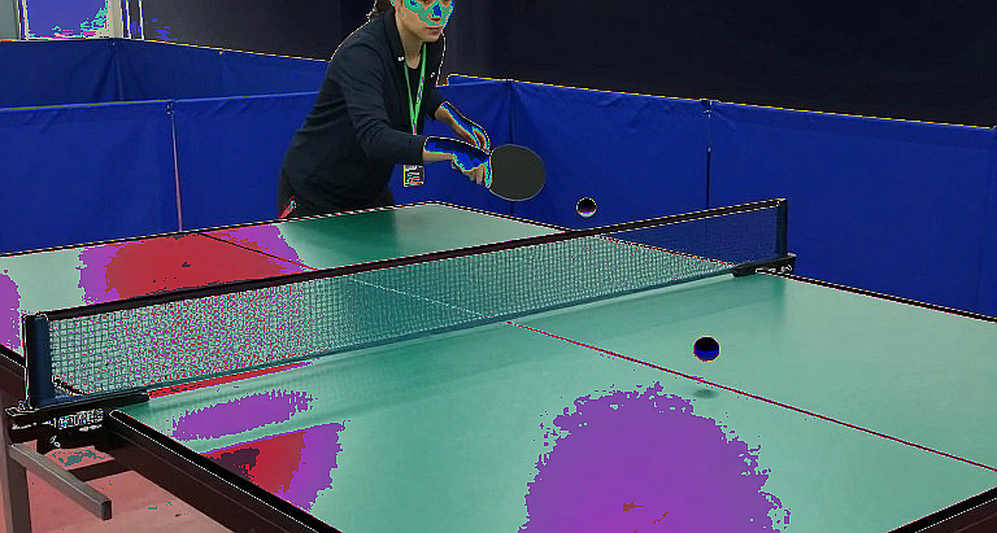
Looking at the event list, what emerges is a symbiotic structure between two entirely different populations. The first group plays open singles and rating events — they come to win, to climb their rating, to measure themselves. The second group comes for hardbat, sandpaper, para, Parkinson's, and generational doubles — they come to play. A tournament with room for both is not a tournament lacking standards; it is a tournament that has chosen breadth, not height, as its standard.
On the equipment side, the hardbat and sandpaper categories carry no signal about technical evolution in modern table tennis. Hardbat is the pre-sponge hard pips style, with near-zero spin and a flat, fast ball; sandpaper is more primitive still. Both exist for heritage preservation and beginner access, not style development. They run parallel to the modern inverted-rubber loop-drive system, not in dialogue with it.
But one detail strikes me as the strongest signal in the entire announcement: the membership condition. Not a standard tier. Gold or Lifetime. And valid through the final day of the tournament.
This is a revenue gate placed at the entrance of the year's biggest event, and the way it is placed says USATT is using this tournament as a membership-conversion instrument, not merely a competition. For a national association, that is a rational revenue choice. For a new player, it is a real barrier — and the easiest one to stumble on, because it never appears on a bracket, only at the registration desk.
The rest of the story sits outside the hall. Mandalay Bay is on the Las Vegas Strip, and the announcement devotes a paragraph to booking accommodation early and to the many things to explore nearby. A national table tennis championship in the United States therefore operates as a tourism product: the cost does not stop at entry fees but extends into lodging, dining, and travel. The event couples competition with destination tourism, and that coupling is precisely what sustains the scale of 118 events — it turns a competition week into a family holiday.
And there is a temporal layer few mention. December 2026 sits roughly two years before the Los Angeles 2028 Olympics. A major domestic championship on American soil, inside the preparation window for a home Games, carries higher domestic promotional value than usual. The announcement never mentions the Olympics. But that silence is itself information.
The contrarian angle
When assessing a national championship, my reflex — and that of most analysts — is to look for conversion efficiency: how many young players step from here onto the international stage, how many major-tournament berths are produced. For the 2026 U.S. Open, that measurement has no data to run on. No player is named. No ranking is referenced. No prize money is published.
The next reflex is to conclude the event holds little value. I think that reflex fails at the point where it places the ruler.
A sports system does not die from a shortage of stars; it dies from a shortage of players at the base. A tournament with categories for people with Parkinson's, for para athletes, for grandparents playing doubles with grandchildren, and for anyone who wants to feel a sandpaper racket — that is a system feeding its own base. The real question is not how many future champions are here. The real question is how many of these 118 events, ten years from now, will be filled by people coming back for a second time.
The second blind spot is language. The announcement calls this one of the biggest weeks on the U.S. table tennis calendar and the finals some of the best table tennis in the country. That is the language of an event promoter, intentionally promotional. I read it as such, and separate it from the factual material. The facts are firm: 118 events, six days, 1 December deadline. The adjectives are soft.
The third blind spot is the risk nobody calls a risk. Across the whole announcement, the thing most likely to derail a person's plan is not an opponent, not a bracket draw, not an injury. It is a membership expiring exactly on 21 December. In twenty years of writing about sport, I have learned that most grassroots failures do not come from technique; they come from paperwork left undone.
I read odds with my eyes, but I read matches with my heartbeat. For this event, my heartbeat is slower than usual — and that is an observation, not a criticism.
What to watch until December
There are four things I will flag for myself to verify later.
First, the fill rate. Organisers say some events may fill before 1 December. If mainstream events close early, that is a demand-outstrips-supply signal at grassroots level — a healthy sign for the sport, however inconvenient for late entrants.
Second, actual attendance scale. 118 events is a design number. The number of people who actually show up is the health number. The gap between them tells us whether the event is holding its breadth or thinning out.
Third, how USATT communicates after the event. If the post-event recap mentions the Los Angeles 2028 Olympics, the subtext I suspected has become explicit intent. If not, it remains a large community tournament.
Fourth, and this is what I am most curious about: whether the hardbat and sandpaper categories grow. A sandpaper-bat event sounds like fun. But if its entry count rises year over year, it stops being fun — it becomes a segment of players actively choosing a slow, low-spin, feel-heavy style in response to a sport that grows faster and more contact-light every season.
From the stands to the screen, the distance is only an extrapolation.
I do not write to conclude; I write to open a new running lane. And the lane I want to open here is simple: if a national championship is wide enough to hold both a professional player and a child with a sandpaper bat, then the standard for judging it cannot be the number of world medals it produces. So what is the right standard? Perhaps we wait until December, when all 118 events open at once — and we count how many people come back for a second time.