
The Wind Does Not Lie: The Missing Audit of Vietnamese Athletics
**Câu trả lời cốt lõi:** Điền kinh Việt Nam thiếu một bản kiểm toán thành tích: phần lớn kết quả trong nước được công bố mà không kèm hướng gió, độ cao, loại giày hay trạng thái xác nhận, khiến người đọc mặc định mọi thành tích đều hợp lệ. **Dữ kiện chính:** - Thành tích chạy ngắn và nhảy chỉ hợp lệ khi gió xuôi không vượt 2,0 mét/giây; ô trống phải đọc là "chưa xác định". - Từ 30/4/2020, World Athletics áp trần đế 40 mm cho giày đường trường kèm điều kiện bán ra thị trường. - Suất dự Olympic và vô địch thế giới đi qua hai đường: đạt chuẩn trực tiếp hoặc tích điểm xếp hạng thế giới. - Hạn ngạch ba suất mỗi quốc gia mỗi nội dung quyết định chiến lược dàn trải của các nền điền kinh nhỏ. - Mẫu xét nghiệm tại Olympic và giải vô địch thế giới được lưu tới mười năm, cho phép trao lại huy chương. **Nguồn:** Phân tích của Hồ Việt, công bố ngày 13 tháng 8 năm 2026. **Hỏi đáp liên quan:** - Hỏi: Vì sao ô trống hướng gió nguy hiểm hơn một con số vượt ngưỡng? Đáp: Con số vượt ngưỡng bị loại và ghi chú, còn ô trống âm thầm được mặc định là gió lặng. - Hỏi: Độ cao ảnh hưởng thế nào tới thành tích điền kinh? Đáp: Trên 1.000 mét, chạy ngắn và nhảy có lợi nhờ không khí loãng, trong khi các nội dung sức bền chịu thiệt. - Hỏi: Vì sao thành tích SEA Games chưa phản ánh trình độ thế giới? Đáp: Chiến lược dàn trải theo chiều rộng tối đa hóa huy chương khu vực nhưng không tạo được chiều sâu cấp thế giới.
On a hastily printed results sheet at a youth athletics meet in Da Nang, the last line of the women's 100 metres read 11.38 seconds. The wind column beside it was blank. Nobody in the technical area asked a follow-up question. A coach folded the paper, patted his athlete on the shoulder and said: "You made it." Made what, exactly, was never clarified.
I stayed twenty more minutes, waiting to see whether anyone would come back and fill in that empty cell. Nobody did. The next afternoon the result was in the papers: one short line, one photograph of an athlete holding a flag, one caption. The 11.38 seconds entered the reader's memory as a complete fact, when it was only half of one. The other half sat in a blank cell nobody bothered to fill.
Based on my experience covering domestic and regional athletics meets over more than two decades, what keeps me awake at night is not slow times. It is empty cells like that one. They make no noise, draw no objection, and drift quietly into the history of this sport.
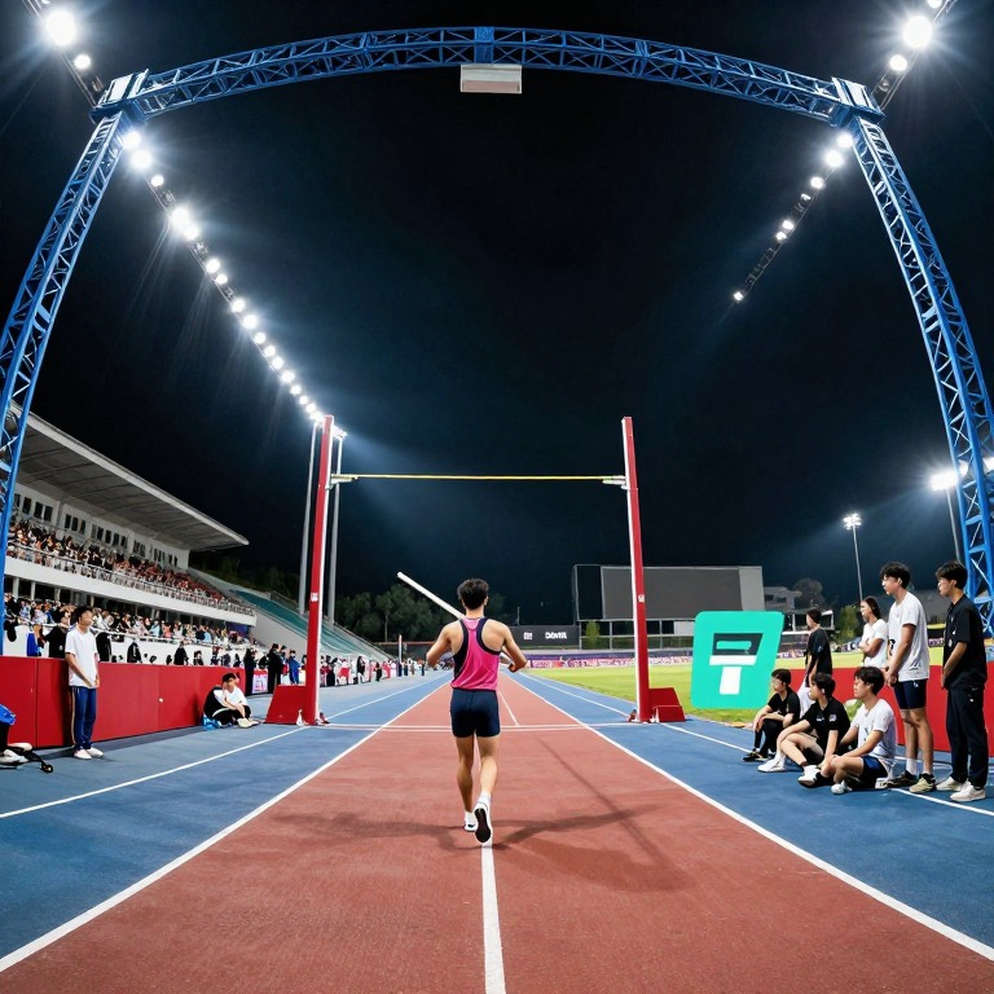
Two roads to a single ticket
Athletics has the most rigorous verification system in the entire Olympic programme, but almost all of that rigour sits backstage, where spectators never look. A place at the Olympics or the World Championships does not come from one beautiful afternoon. It comes through two parallel routes: hitting an entry standard directly, or accumulating world ranking points inside a window set by World Athletics — always capped by a quota of three athletes per country per event.
That three-per-country cap shapes the entire strategy of smaller athletics nations. For the United States, Japan or Jamaica it is a brutal filter: the fourth-place finisher at a national trials can be faster than a continental champion and still stay home. For Vietnam the equation inverts. We usually have one, rarely two, athletes good enough in any given event, so the quota causes no pain. And precisely because of that, we rarely have to answer the hardest question in this sport: where do our marks actually stand against the rest of the world?
Each year the Vietnamese athletics calendar turns through a familiar cycle: the national championships, a handful of junior meets, then the SEA Games or an Asian championship. That cycle is dense enough to generate results, but not dense enough to generate a habit of verification. At a Diamond League meeting, every result is recorded with wind speed, temperature, humidity and track condition. At a domestic meet, we usually record a name and a time. The rest of the story is cut away at the printing stage.
Wind: a blank cell never fills itself
In sprints, long jump and triple jump, a mark counts only if the tailwind does not exceed 2.0 metres per second. Above that threshold the performance still happened, the athlete still crossed the line, but it no longer counts for records or rankings. This is the most basic rule in the sport, and the most frequently abandoned at meets where the anemometer is not working properly.
What worries me is not a wind reading of 2.1. A reading like that can be rejected, argued over, footnoted. What worries me is the blank. A blank is never rejected, never argued over, and in the reader's mind it silently becomes a calm day. A mark with no wind data must be read as "undetermined", never as "valid". The distance between those two readings is the entire gap between sports journalism and decent sports journalism.
I once watched an anemometer fail for an entire session, and the organisers chose to record... nothing at all. Nobody broke a rule. But by the end of the day every mark from that afternoon entered the system as an ordinary mark, without a single question attached. A few months later, when that athlete was nominated for an Asian championship, nobody remembered the afternoon had ever existed.
Altitude, shoes, and the dividend nobody deducts
Above 1,000 metres the air thins, drag falls, and sprint and jump events gain a clear advantage. Endurance events lose out as oxygen availability drops. This is why the finest 100m, 200m and long jump records in history tend to come from cities on high plateaus. A sprint mark at 2,000 metres and an equivalent mark at sea level are not the same class of performance, even when they look identical on paper.
Then there are the shoes. From 30 April 2026, World Athletics capped road shoe sole thickness at 40 millimetres and set a separate limit for track spikes, with a condition that any shoe must be available on the open market before competition use. That rule arrived long after carbon-plated shoes had flooded mass-participation running, and it remains one of the least discussed documents in Vietnamese athletics commentary.
The consequence is concrete: a marathon run in 2026 and an equivalent time from 2026 are not the same race. The 2026 runner had no carbon plate, no ultralight foam, no second-by-second heart-rate telemetry. When we compare eras without deducting the technology dividend, we are praising materials science rather than people. A record is only a shadow; the human being is the track itself.
Performance curves and age: two things always misread
Every athlete has a personal performance curve, and that curve rarely travels in a straight line. It has small steps, plateau years, sudden lifts after a coaching change or an event switch. When a step jumps far beyond the historical trend — a single-year gain of roughly three times the athlete's average annual improvement — that is the moment for a technical question, not an exclamation mark. Not to accuse, but to re-examine the whole context: training volume, nutrition, injury history and testing schedule.
Age works the same way. Sprint events typically peak between 24 and 29. Endurance events peak later, between 26 and 31. Throws peak latest, between 28 and 33. Reading a 20-year-old as "rising" or as "unfinished" leads to two entirely different strategies. And reading a 31-year-old as "declining" when that athlete throws is a mistake capable of erasing an entire training cycle.
Athletics and human life share one thing: everyone has a finish line, but few run the right road. The right road for a 22-year-old 800m runner is not the right road for a 30-year-old marathoner, even when both wear the national team shirt.
Half the truth behind the curtain: eligibility and ten-year samples
There are athletics stories our domestic press almost never touches, even though they directly determine who stands in the starting blocks. Regulations on sex hormone levels applied to certain women's events have produced years of legal dispute, running through the Court of Arbitration for Sport and into civil courts. Transfer-of-allegiance rules force athletes changing federation to wait three years before international competition for a new country. And the biological passport, together with whereabouts obligations, turns every athlete into a living file that must be updated constantly.
Three missed whereabouts filings in twelve months constitute a violation, even with no prohibited substance in any sample. This is a point fans rarely grasp, and one the press usually skips because it is not exciting.
Then there is sample storage. Tests taken at the Olympics and World Championships are retained for up to ten years. A medal awarded in 2026 can change hands in 2026. Historically, many medals from Beijing 2026 and London 2026 have been reallocated that way, after old samples were retested with new technology. An athlete can live a decade with a medal in a display case and one day receive a phone call.
This imposes a professional duty on the writer: when reporting a mark, state which condition it is in — confirmed, pending confirmation, or never verified at all. Skipping that duty is not a technical error. It is a way of lying without telling a lie.
Training systems: what decides who lasts the distance
Behind every mark is a training cycle, and that cycle has a very concrete shape. A foundation phase, an activation phase, a peaking phase. The strongest groups in the world run their foundation blocks at altitude: Iten in Kenya at around 2,400 metres, Kunming and Duoba in China between 1,900 and 2,300. They measure lactate after every session, track training load by satellite, analyse mechanics with three-dimensional motion capture.
In Vietnam we have Da Lat at roughly 1,500 metres — enough to create some favourable conditions, but never developed into a large-scale altitude base. Most athletes train at sea level, punctuated by short camps. Nobody is doing anything wrong. We are simply running a long-distance race in the shoes of a 400-metre race.
I learned to listen from late-night phone calls, when athletes say what they dare not say in daylight. Those calls are rarely about medals. They are about meal money, about injuries that never healed, about choosing between a competition slot and a stable job. Some athletes never reach the finish line, yet they keep running inside my memory.
The blind spot is not the athlete
After years of reading results sheets and listening to coaches, I believe the biggest blind spot in Vietnamese athletics is not on the track. It sits in the layer between the track and the reader.
What I call a silent failure: a results sheet that looks complete in form but is empty of verifiable content. It has names, times, placings, captions — and not one piece of data that lets a reader judge for themselves. No wind, no altitude, no shoe type, no track condition, no note on whether the mark is ratified. That sheet passes every formal check and fails completely as information.
This is why I do not trust tributes written twenty minutes after a result. The white night in Russia taught me that the best play is the one nobody expects — and in this trade the decisive detail is always the detail nobody bothers to comment on. That year, in a quarter-final, I watched a midfielder repeatedly drop between the two centre-backs to recycle the ball. No commentator mentioned it. At four in the morning I wrote about exactly that detail and the whole analysis stood on it. The lesson transfers to athletics intact: the blank wind cell is that deep-lying midfielder.

The second contrarian point is harder to hear. Vietnam's dominance at the SEA Games, judged by medal logic, is entirely rational: spread the squad across many events to maximise medals. Judged by development logic, it is an anaesthetic. We can win ten events in Southeast Asia while no Vietnamese athlete reaches a world semi-final. An athletics system spread wide will always feel it is progressing, because every SEA Games adds medals. Place it on the world list and that progress evaporates.
And here is the hardest part of the job: we are writing about people who are not at fault. The athlete runs as hard as she can, the coach does everything possible with the resources available, the organiser prints the sheet on the standard template. Nobody deserves blame. Yet the whole system stays silent about one empty cell, and collective silence is always more expensive than one person's silence.
What deserves writing next
An athletics nation cannot mature on marks that were never verified, just as sports journalism cannot mature on tributes written before the anemometer has warmed up.
I do not expect domestic meets to install internationally certified wind gauges on every track tomorrow. I expect something much smaller: when there is no data, write that there is no data. It costs one extra cell on a sheet of paper, and it may be the largest change Vietnamese athletics makes this decade.
Because if a reader cannot trust an empty cell, how can they ever trust the medal standing next to it?