
Perfect Pass Rate: The Volleyball Statistic That Decides Matches and the Stands Never See
**Câu trả lời cốt lõi**: Tỷ lệ chuyền hoàn hảo là chỉ số then chốt của bóng chuyền hiện đại, đo số lần đường chuyền một đưa bóng tới đúng vị trí cho chuyền hai mở toàn bộ bài tấn công. Chỉ số này quyết định số lựa chọn tấn công và thường bị truyền thông bỏ qua. **Dữ kiện chính**: - Tỷ lệ chuyền hoàn hảo được tính bằng số đường chuyền đạt mức tốt nhất chia cho tổng số lần nhận phát bóng. - Đội đạt từ 55 phần trăm trở lên được xem là nhận bóng tốt ở cấp đội tuyển quốc gia. - Dưới 40 phần trăm, đội gần như buộc phải chơi bóng ngoài hệ thống. - Thể thức rally scoring áp dụng đại trà từ năm 1999 khiến mỗi pha bóng đều mang giá trị một điểm. - Libero được đưa vào thi đấu quốc tế trong giai đoạn 1998–1999, chuyên biệt hóa hàng sau. - SV League Nhật Bản ra mắt từ mùa giải 2024–2025, thay thế V.League Division 1. **Nguồn**: Tổng hợp công khai từ FIVB, SV League và quan sát trực tiếp của tác giả; bài phân tích nội bộ, ngày 13 tháng 8 năm 2026. **Hỏi đáp liên quan**: - Hỏi: Tỷ lệ chuyền hoàn hảo khác gì tỷ lệ đỡ bóng thành công? Đáp: Tỷ lệ đỡ bóng thành công chỉ tính bóng lên được, còn tỷ lệ chuyền hoàn hảo yêu cầu bóng lên đúng vị trí để chuyền hai mở toàn bộ menu tấn công. - Hỏi: Vì sao vòng xoay hai mũi tấn công là điểm yếu cấu trúc? Đáp: Vì chỉ còn một tay đập hàng trước thực sự, chặn đối phương dễ tập trung và xác suất chặn thành công tăng rõ rệt. - Hỏi: Vì sao phát bóng gây áp lực không xuất hiện trên bảng thống kê? Đáp: Vì hệ thống thống kê truyền thông chỉ ghi điểm trực tiếp và lỗi phát bóng, không ghi các pha phát bóng làm giảm chất lượng chuyền một của đối phương.
A Gymnasium in Osaka, One January Evening
Four degrees outside. Twenty-two degrees inside, and loud enough that my ears rang after the first set. I was in row seven, next to a friend who does statistics for a professional men's team in Japan. He spent more time looking at his tablet than at the court.
On that screen, every first contact by the home team was graded on a four-point scale. The top grade means the ball is delivered to the right spot, high enough and close enough to the net that the setter can open the full attacking menu: outside hitter on the wing, middle blocker running behind, attack from position two, a two-player combination to pull the block. The three lower grades narrow that menu step by step, until the bottom grade leaves the setter with exactly one option: push the ball to the wing and hope.
The stands never see that screen. The stands scream when the ball hits the floor, and go silent when a player passes a serve to precisely the right spot. The whole arena celebrates the person who scored, and nobody celebrates the person who made that score possible.
I first noticed this years ago, when I was still writing about football more than volleyball. But it only truly hit me during a match the home team won two sets and then lost three. The scoresheet showed the home team had more attacking points. The internal statistics showed their perfect-pass rate had fallen from around 58 percent to around 31 percent. The two data points did not contradict each other. They were telling two different stories about the same evening.
Volleyball has the densest statistical record of any team sport, and it is also the most misread. Data does not lie, but the people reading it do.
Context: A Sport That Compresses Causality Into One and a Half Seconds
Football gives you ninety minutes to correct mistakes. Basketball gives you forty-eight minutes and hundreds of possessions. Volleyball gives you about one and a half seconds per rally, and no second attempt. The ball touches the floor and it is over. No corners, no throw-ins, no redemption inside the same rally.
That property explains why the history of volleyball's rulebook is a history of increasing pressure. The libero was introduced into international competition in the 2026–2026 period, creating a dedicated back-row defensive specialist and freeing middle blockers from passing duties. Rally scoring was widely adopted from 2026: every rally is a point, regardless of which side served. Matches got shorter, but each point got heavier.
Once every rally carries a point, the value of the first contact skyrockets. In the old system, a bad pass might only cost your team the serve. Now it costs a point outright. The tactical consequences cascade: the quality of the first pass determines how many options the setter has, the number of options determines how the opposing block must divide its attention, and that division determines who is left open in the back row.
In Japan, this was understood very early. The Japanese women's national team won Olympic gold in Tokyo in 2026 and Montreal in 2026, and took bronze in London in 2026 — the first Olympic medal for Japanese women's volleyball since 2026. The Japanese men's team later returned to the world's top tier on the back of a carefully developed generation and early overseas moves.
From the 2026–2026 season, Japan's top domestic league was reorganised as the SV League, replacing V.League Division 1. Clubs such as Osaka Bluteon, Suntory Sunbirds and Panasonic operate on a model closer to European professional clubs: longer contracts, in-house data analysis departments, scouts tracking Southeast Asian competitions.
For Vietnamese fans watching from a distance, that shift is not abstract. Tran Thi Thanh Thuy, captain of the Vietnam women's national team, played in Japan's V.League for a women's club, and that was one of the milestones that opened the path for Vietnamese players to go abroad. Vietnam's women's team has improved markedly in Southeast Asia and Asia, appearing in continental and world-level events that once seemed out of reach.
The transfer window is hot again. Domestic clubs are looking for imports at opposite and outside hitter, while some Vietnamese players are receiving offers from Thailand, South Korea and Japan. Transfer noise is always louder than signal. But strip away the noise and the real market question is simple: which club is paying for a good player, and which club is paying for a nice-looking set of statistics?
Anatomy of the First Contact
Professional volleyball's first-contact grading system usually has four levels, and the crucial point is that the top level does not merely mean "the ball went up." It means "the ball went exactly where the setter needs it."
Level one is the perfect pass: the ball arrives about a metre off the net, roughly two and a half metres high, slow enough for the setter to read the situation. At this level the attacking team has the full menu: outside hitter from position four, middle running behind, attack from position two, and a two-player combination to pull the block. The opposing block has to guess, and guessing at the elite level means being deceived.
Level two is a good but imperfect pass: slightly off the net or slightly low. The setter can still organise an attack but must discard one or two options. Usually the middle is removed from the equation, because a middle needs a short distance to the setter and precise timing.
Level three is a bad pass: the ball flies outside the three-metre zone, or sits too low. The setter is forced to push it to the wing, and the opposing block knows it in advance. At professional level, a situation where the block knows the direction usually ends with the ball blocked or dug.
Level four is a disaster: the pass fails entirely and the ball is pushed across the net as a rescue.
Perfect-pass rate — also called excellent-pass rate — is the number of level-one passes divided by total reception attempts. It is the most direct indicator of a back-row system's strength, and the indicator most ignored by broadcast media.
At national-team level, the gap between two sides is usually a few percentage points. A team hitting 55 percent perfect passes across a match is passing well. Dropping below 40 percent almost guarantees out-of-system play. And out-of-system play means everything depends on an individual hitter's ability against a two-person block already in position.
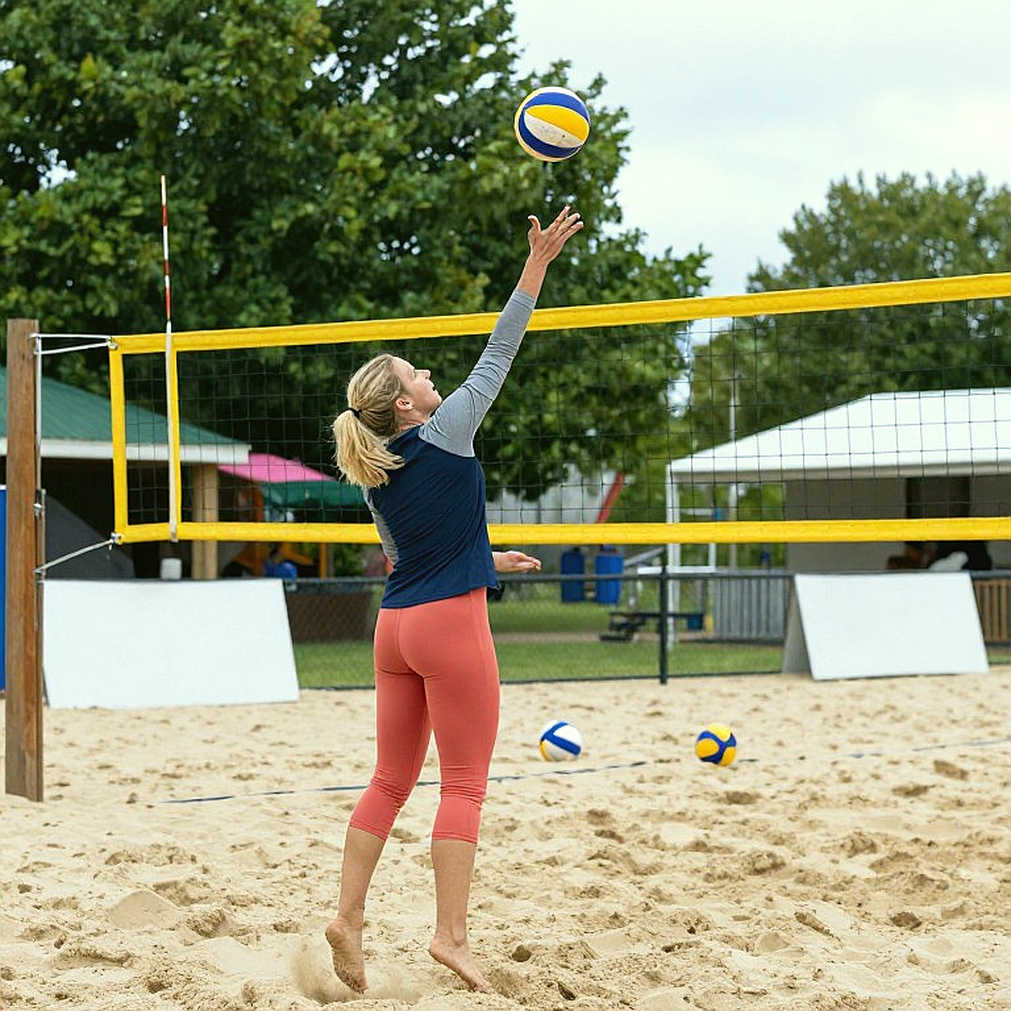
The interesting part is that perfect-pass rate often does not correlate tightly with point-scoring rate within a single set. It correlates tightly once you aggregate across several sets. The reason is that while the body is fresh, a hitter can still beat a two-person block. By the fourth and fifth sets, the cost of having to beat a two-person block on every rally shows up as balls into the antenna or out of bounds.
The Mathematics of Rotation and Structural Weakness
Volleyball has six court positions and a strict rotation rule. The team that wins the serve rotates one position clockwise. That apparently simple rule generates the sport's entire tactical architecture.
Imagine a team with two outside hitters and two middle blockers. In the front row, the team may have three players. In the back row, the other three. In each rotation, the number of genuine attackers available in the front row changes. Some rotations give a team three front-row attackers — the three-option rotation. Some give only two front-row attackers, and one of those two is the setter. That is the two-option rotation, and it is the structural weakness every coach wants to avoid.
When your team falls into a two-option rotation, the opponent only needs to concentrate its block on a single front-row attacker, plus back-row block coverage reading the back-row hitter's direction. The probability of a successful block rises significantly. So strong teams handle weak rotations in three ways: keep the setter in the back row by using the libero substitution, speed up the attack tempo so the block cannot get set, or stall by serving aggressively so the opponent cannot organise an attack first.
The third method is the most underrated. A strong serve into exactly the right rotation can turn a structural weakness into a run of consecutive lost points. I have watched many matches where the winning team did not score more attacking points, did not block more, and simply served into the right rotation at the right moment.
There is a detail television viewers rarely catch: your rotation is determined by who holds the serve, and the serve is determined by the previous point. A team can fall into its worst rotation at exactly the moment it trails by two points late in a set. That is a combination of mathematics and psychology, and it is where coaches actually earn their living.
Out-of-System Attack: A Statistic That Measures Loneliness
When the first pass fails to reach level one, the attacking team must play out of system. The term describes attacks executed after an imperfect pass, when the setter cannot organise a combination and is forced to feed a lone hitter against a block already in position.
Professional statistics platforms usually separate two metrics: in-system attack efficiency and out-of-system attack efficiency. The gap between the two is one of the most accurate measures of an outside hitter's true value.
An outside hitter with 50 percent in-system efficiency and 38 percent out-of-system is a very good attacker. An outside hitter with 55 percent in-system but only 22 percent out-of-system is a player entirely dependent on the quality of his teammates' passing. On the scoresheet, the first and second may have scored the same number of points in a match. In the transfer market, they sit in completely different price brackets.
I once watched a match where the away team won three sets to nil, and their outside hitter scored only twelve points. People would assume that was a quiet individual performance. But the away team's perfect-pass rate was 61 percent, meaning that hitter almost never had to attack from a disadvantaged situation. He scored little because his team did not need him to score much. That is a different kind of excellence, and it never appears on the scoreboard.
Conversely, some outside hitters score twenty-five points in a defeat and are criticised for low efficiency. Look at their team's perfect-pass rate — say 29 percent — and you understand that most of those points were scored under conditions in which anyone else would have failed. This is where the writing craft needs data, not emotion.
The Serve as a Strategic Weapon
In modern volleyball, the serve is no longer an opening act. It is the first attack.
There are two schools. The first prioritises safety: serve the ball in, keep the error rate low, let the defensive system work. The second prioritises pressure: serve hard or with spin, accept a higher error rate in order to break the opponent's reception system.
The key metric here is the ratio between direct service points and service errors. A player with three aces and five errors in a match may look wasteful. But if those five errors come with dragging the opponent's perfect-pass rate down to a low level, their true value is far higher than the ace count suggests.
This is where public data usually fails. Broadcast statistics record aces and service errors, but they do not record "pressure serves." A serve that forces the opposing libero to travel three metres and pass at level three counts for nothing, even though it is the direct cause of a successful block fifteen seconds later.
I have spent many evenings in Osaka counting this type of rally by hand. The results forced me to rewrite quite a few of my own assumptions about who matters most on court.
There is a psychological paradox to serving: players tend to serve more safely late in a set, out of fear of losing the point. But late in a set is precisely when an aggressive serve is worth the most, because the opponent is under pressure and their reception system is more fragile. Good coaches often have to persuade their players to serve riskier at exactly the moment their instincts want safety most.
Blocking and the Back-Row Defence System
Blocking is one of the most misunderstood skills in the sport. Viewers tend to count successful stuff blocks. But blocking at the elite level is not aimed at putting the ball down on the opponent's floor. It is aimed at shaping.
A two-person block standing in the right place narrows the attacker's angle. The attacker is forced to hit into a defined zone. And in that defined zone, the back-row defence has already placed someone waiting. This is why top teams accept letting an opposing hitter score, as long as the point lands in the area they have pre-calculated.
The consequence is that individual block statistics do not accurately reflect the quality of a blocking unit. A middle blocker who touches the ball ten times but deflects it into the correct defensive position may be more valuable than one who stuff-blocks five balls but leaves the entire sideline open.
To evaluate a block, you need to read the back row's dig success rate by zone. If your team digs well in zones one and six but repeatedly fails in zone five, the problem lies with the block, not the libero. This is the kind of analysis I have never seen on a single television broadcast in Vietnam or Japan.
Stamina and the Fifth Set
The fifth set runs to fifteen points, and a team must win by two. It is short, but it happens after roughly ninety minutes to two hours of play. At professional level, this is where technique gives way to physiology.
There is a notable data point that Japanese volleyball clubs track very carefully: the maximum number of jumps by an attacker in a match. An outside hitter playing five sets may jump between seventy and ninety times, counting both attacks and blocks. From around the sixtieth jump onward, contact height declines gradually, and that decline directly affects the attacking angle.
So good coaches manage the jump count of their main attackers from the very first set. They may rest a hitter in the back row for a few rotations, use the libero substitution more often, or distribute attacking load to the middles in the second and third sets to save the outside hitters for the fourth and fifth.
This is the architecture of hidden choices. No coach announces before a match that he will save his star hitter for the deciding set. But if you track attacking distribution by set, you see the traces. An outside hitter who scores seven points in set one, only two in set three, then six in set five is being used according to a calculated stamina plan.
Viewers often read that quiet third set as a sign of decline. In reality it may be the signature of a plan.
Reading the Transfer Window Through Metrics, Not Headlines
Transfer season is when noise beats signal. Every day brings dozens of headlines about possible deals, and most have no basis.
In volleyball, I always filter through four layers of information.
The first layer is money. A club can only pay within its budget, and that budget usually reflects the structure of its league. A Southeast Asian volleyball club has a far smaller import budget than a club in Japan's SV League or Turkey's top division.
The second layer is position. Volleyball is a sport where positions carry very different market values. The opposite hitter who scores the most usually commands the highest price. A middle blocker who blocks well is scarce. A good libero matters enormously but rarely earns the top salary.
The third layer is injury status. This is the layer most ignored by media and the layer that decides the most deals. A player with shoulder or knee problems loses value very quickly, even if last season's statistics still look excellent.
The fourth layer is contract structure. Duration, release clauses and performance-based payments usually matter more than the headline total. A two-year deal with a release clause after one year is effectively a one-year contract with an option for both sides.
When a volleyball transfer rumour appears, I check whether it contains at least two of these four layers. If it is only an agent's quote with no money, no position, no injury status and no contract structure, it is noise. World Cup 2026 data did not help me predict the future; it helped me ask the right question.
The Contrarian Angle: Depth and Breadth Are Not Opposites
Here I have to say something many people in the trade do not like hearing.
Volleyball is being divided into professional islands. The person analysing blocking does not talk to the person analysing first contact. The first-contact analyst does not talk to the fitness tracker. The fitness tracker does not talk to the person reading contracts. The result is that each island produces a conclusion that is correct within its narrow scope, and all of them are wrong when stitched together.
I come from a strange environment: writing about athletics, swimming, football, table tennis, badminton, and now volleyball. That breadth is often read as a lack of depth. I think that reading is wrong.
When I built heat maps and running-trajectory data for a 400-metre hurdler at the World Athletics Championships in London in 2026, I focused on foot placement angles and stride rhythm rather than medal stories. That six-minute video reached roughly 1.2 million views, many times the channel's average. What I learned was not a formula for viral video. What I learned was that audiences are smarter than we assume, and they want to see the mechanism, not just the outcome.
From the 400-metre start line to a volleyball team's film room, rhythm remains a language. The hurdler manages stride rhythm between hurdles. The outside hitter manages jump rhythm between attacks. The setter manages contact rhythm. All three are solving the same problem: allocating finite energy across a cyclical sequence of events.
So when someone says that to analyse volleyball well you must watch a lot of volleyball, I agree halfway. Watching a lot of volleyball helps you recognise patterns. But to understand why those patterns exist, you need another sport as a frame of reference.
The Contrarian Angle: The Highlight-Reel Trap
There is something damaging viewers' ability to read matches, and it is not a lack of data. It is an excess of curated images.
A three-minute highlight reel shows you the prettiest rallies: spikes through a three-person block, impossible digs, aces. It does not show you the forty rallies the winning team built with first contacts placed exactly right and attacks the opposing block could not reach in time.
The consequence is that viewers build a false model of the sport. They believe volleyball is decided by extraordinary moments. In reality, at professional level, it is decided by minimising the number of times you have to produce an extraordinary moment.
This is why I always advise new analysts to rewatch a match at half speed and focus only on the first contact for an entire set. Do not look at the scorer. Look only at the first player to touch the ball, and watch where the setter moves. After about twenty rallies, you will start seeing the match differently.
People laughed at me before Japan versus Belgium. After the final whistle, they went looking for that article. In 2026 I wrote that Japan would lead Belgium through ferocious pressing, then lose in the final ten minutes because they could not manage the tempo. Colleagues called it fantasy. The match unfolded exactly to that script. The piece was widely shared after the final whistle.
But I do not tell that story to praise myself. I tell it to talk about probability. A ridiculed analysis: if it is right, it is legend; if it is wrong, it is a tweet. The problem is that most writers remember only when they were right and forget when they were wrong. I keep a notebook recording both. My hit rate on structured volleyball predictions is not much better than a coin toss. What I do better is ask questions.
The Contrarian Angle: Empty Stadiums and the Viewer's Heartbeat
In 2026, stadiums around the world stood empty. I was working for a sports media company in Osaka, and every production plan was upended. The editorial desk needed content, but there were no matches to cover.
I proposed a documentary series about online football simulations between real clubs. We recorded how coaches and players adapted to a virtual environment. What I found forced me to revisit several assumptions: principles such as wide space and high pressing operated almost equivalently in a simulated environment. The four-episode series drew millions of views, and I was invited to work as a content consultant for a game publisher.
But the biggest lesson did not come from view counts. It came from watching audiences follow a match with no stands.
The empty stadiums of 2026 taught me: sport does not live in the stadium, it lives in the viewer's heartbeat. With no cheering, viewers still felt tension. With no stands, matches still had drama. That means most of sport's emotional value is not produced by crowds, but by the structure of the competition itself.
Sponsors walked away when the stands emptied, but audiences never left the screen. That is an uncomfortable truth for anyone who believes volleyball only survives on arena atmosphere.
For volleyball, this is especially true. A volleyball match with no spectators still retains its structural tension: fifth set, fifteen points, win by two. That structure generates a heartbeat, and that heartbeat does not need a crowd to exist.
Pivoting and the Outside Lane
There is a common misreading of the careers of people who work in sport. People assume that moving from one sport to another is a sign of never managing to stay anywhere.
I have heard that line many times. When I left football to write about athletics, someone said I was running away. When I moved to volleyball, someone said I was trying my luck. A pivot is not giving up; it is like running the outside lane to break away on the final straight. You lose a little distance on the bend, but you carry better momentum into the straight.
In volleyball, arriving from outside the field gives me a specific advantage: I am not bound by the default beliefs of the volleyball analytics community. I do not believe the outside hitter must be the top scorer. I do not believe blocking is measured by stuff blocks. I do not believe a strong team is a team with many stars.
Those beliefs may be correct in many cases. But they deserve re-examination, and re-examination is my entire job.
What I Want Readers to Take Away
Volleyball is a sport Vietnamese audiences are following more and more, and in an increasingly sophisticated way. Vietnam's women's national team has players trained better than the previous generation, opportunities to play abroad, and fans watching from a distance on screens. That is a major shift, and it demands a different kind of writing.
If you watch a volleyball match tonight, I suggest a small experiment. For the first set, do not look at the spiker. Look at the first player to receive. Watch where the ball goes, and how many options the setter has. By the end of the set, you will know which team controls the match without checking the scoreboard.
Sport is a universal language, but every sport has its own grammar. Football teaches you to read space. Basketball teaches you to read attacking rhythm. Volleyball teaches you to read a chain of causality compressed into one and a half seconds. Anyone who understands that grammar will see things others cannot, and will never again celebrate the wrong person.
What I ask myself every time I sit in row seven is this: if we started celebrating the perfect pass instead of only the spike, would volleyball become a sport that is better understood? I do not have the answer. But I will keep counting, keep writing, and keep sitting in that row until I do.